Friday, January 23, 2015

Ancient Egypt: Crash Course World History #4


Video Breakdown
     Group
  • ________Intro to Ancient Egypt                            0:00 - 1:40
  • ________The Nile, Agriculture & Egyptian Life 1:40 - 3:30 
  • ________The 3 Dynasties/Kingdoms                     3:30 - 4:00
  • ________The Old Kingdom(2,649-2,152 BC)       4:00 - 6:14
  • ________The Middle Kingdom(2,040-1,640 BC) 6:15 - 7:52
  • ________The New Kingdom(1,550-1,070 BC)      7:52 - 9:18
  • ________The Open Letter to King Tut                9:18 - 10:27
  • ________The Crucial Thing to Remember        10:27 - 11:10

What did you learn from the video? Just like we can close read a novel, we can closely watch or examine a video. 

Directions:

  • Re-watch your assigned sections. You may re-watch them, pause them, replay them and jot down as many notes and as much information as you want.
  • Break down the information and pull out the the most important details and organize what you learned. 
  • Use chart paper and markers to create a poster to represent the information.
  • You must:
    • Include a Title
    • Write LARGE AND NEAT!!!
    • Present accurate information about your topic
      • Information should be clear and easy to understand
    • Put the names of your group members on the back
  • You can include:
      • words
      • pictures
      • charts
      • timelines
      • sentences
      • etc...
*****Important*****
These Posters are intended to help introduce us to the Ancient Civilization of Egypt. I do not expect you to become a master of this information yet. We will be studying Egypt in depth over the next several weeks.


Monday, December 1, 2014

Unit 2: Lesson 8 The 4 Main Ancient River Civilizations Overview


  • I can record information about ancient civilizations.
  • I can make comparisons between the 4 main ancient river civilizations to see how they are similar and how they are different 
  • I can name and locate the 4 main ancient river civilizations on a world map.
The 4 Main Ancient River Civilizations
1. _________________________
2. _________________________
3. _________________________
4. _________________________


1. Mesopotamia
2. Egypt
3. Indus Valley
4. China


Wednesday, November 5, 2014

Unit 2: Lesson 4 - Early Humans 11/5/14

Quiz: Timeline Vocabulary


  • I can record notes about Early Human Civilizations.
  • I can understand the difference between the Neolithic and Paleolithic Ages. 
  • I can make inferences about human advances & innovations during the Neolithic Age.


Homework: Write a paragraph explaining in your own words how the 3 big human advances changed early civilizations. 

Friday, October 24, 2014

Lesson #14 - Review for Geography Unit Assessment

Today we will be reviewing 
for our Geography assessment 
that we will be taking on 
Monday, October 27.  

Geography is the study of the __________________________

How many continents on planet Earth?_______
Name them.
________________________________________


How many oceans?________
Name them.
________________________________________


How many Hemispheres? ________
Name them.
________________________________________


How many years are in a decade? _______
How many years are in a ‘score’? _______
How many years are in a century? _______
How many years are in a millennium? _______


Work in your Triad Groups to complete the Review Packet of information. I will be collecting them tomorrow and taking them as a homework grade. 


Wednesday, October 8, 2014

Lesson #11 - Ye Old Pumpkin Patch

For Lesson 11
I can collaborate effectively using the Triad Talk Expectations.

I can plot coordinates on a grid using Latitude and Longitude.

Directions:
The following coordinates are the midpoints of each of ten pumpkins that are found in the pumpkin patch. Plot the pumpkins in the pumpkin patch by using the latitude and longitude coordinates below. After plotting the pumpkins, decorate the pumpkin patch as you wish. However, while decorating make sure that the latitude and longitude point plotted can be seen on the pumpkin. The example below shows what a sample pumpkin may look like. 


Homework: Finish Ye Olde Pumpkin Patch
This assignment will be collected for a grade.
  • Each properly plotted pumpkin is worth 10 points


Tuesday, October 7, 2014

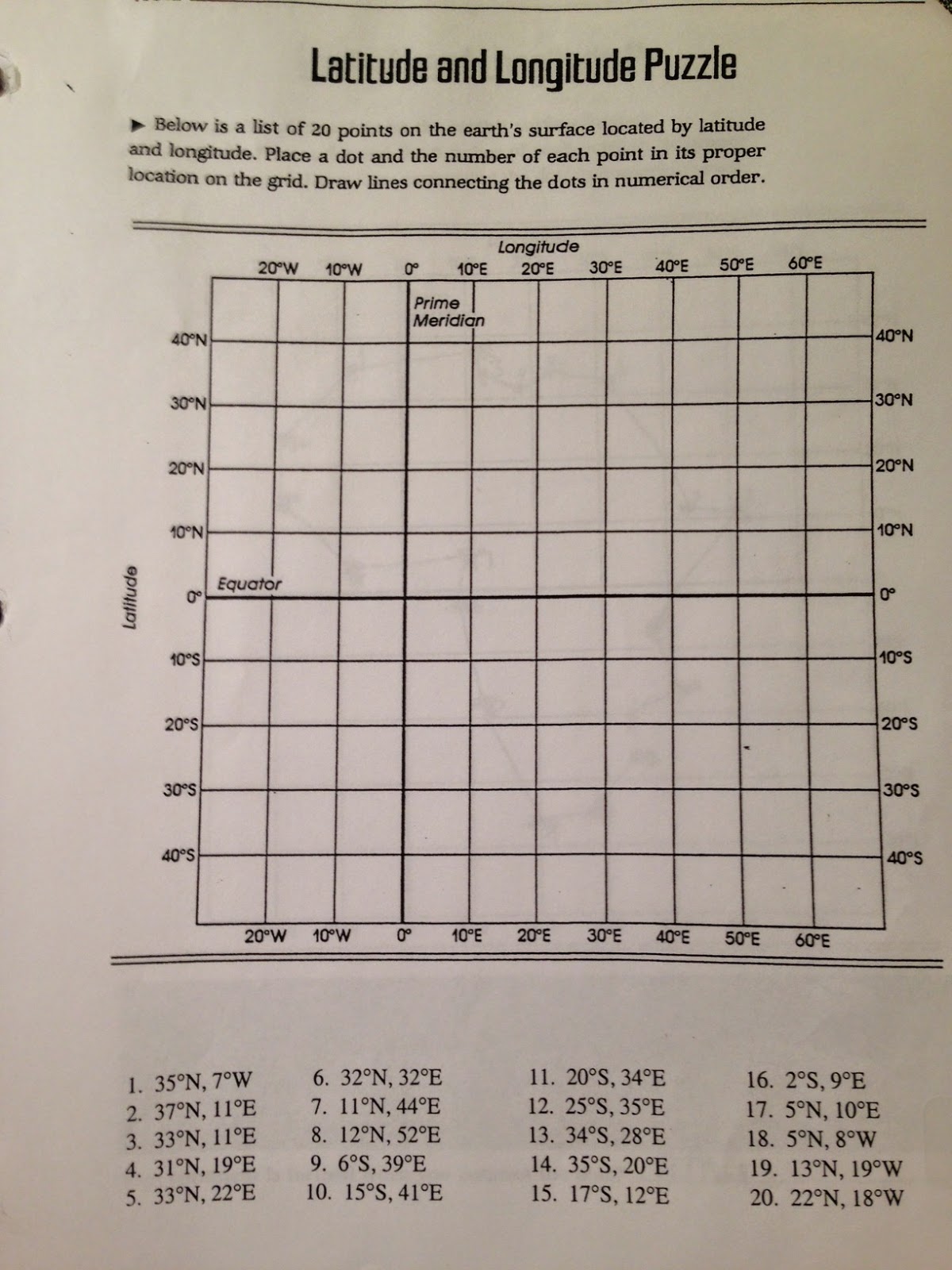
Lesson #10 - Latitude and Longitude Puzzles

For Lesson 10


  • I can use my knowledge of Latitude and Longitude to solve a map puzzle.
  • I can place coordinates on a grid to mark points on a map.


Directions:

  • Choose one of the Latitude and Longitude Puzzles.
  • Use the Coordinate pairs to mark points on the map. 
  • Connect the point in numerical order to solve the puzzle.
Puzzle #1

Puzzle #2


Friday, September 26, 2014

Lesson #7 Using Historical Maps & Resource Maps


  • I can read information from a resource map & from a historical map.
  • I can use a map key to discuss Mexico’s resources and Indian Empires.
  • I can use my World textbook as a reference source when responding in writing. 

Directions: 
1. Read pages G4-G11 in your World textbook.
2. Read pages 12 & 13 in your World textbook.
3. Fill in each blank to complete the note taking worksheet. 
4. Respond to the questions on page 3 & 5.